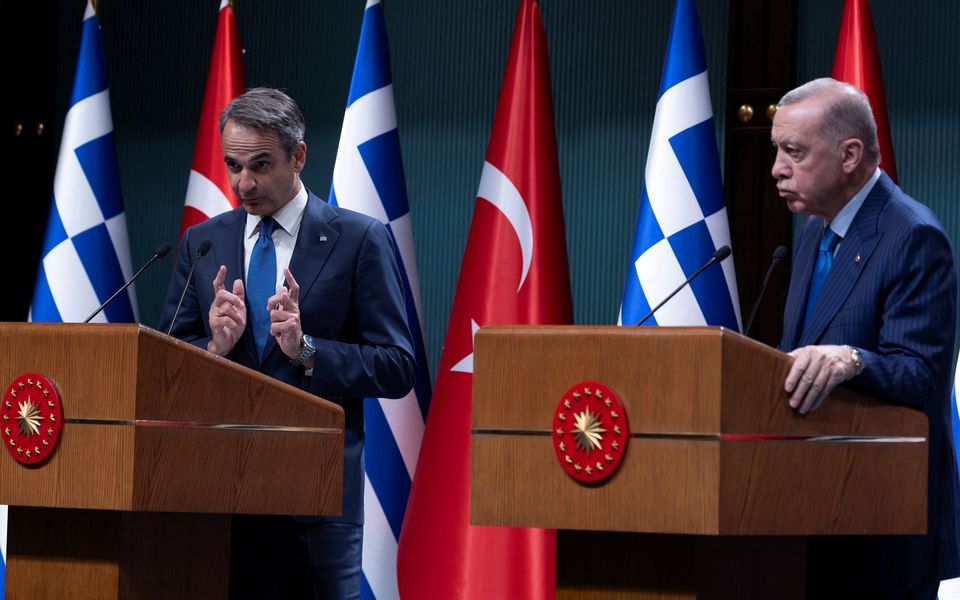
The Ankara NATO summit dominated the geopolitical agenda. Erdogan, following bilateral exchanges with Mitsotakis, proposed renewed dialogue on Aegean issues, suggesting a first step at foreign minister level and a possible leaders' meeting thereafter. Mitsotakis pressed publicly on the casus belli — describing it as "a historical anomaly" whose time has passed — and raised concerns about Turkey's potential F-35 access, while carefully noting it is not Greece's role to dictate US arms sales. Erdogan dismissed both the casus belli issue and Greek objections to F-35s with unusual bluntness, saying Mitsotakis "should not have made such a mistake," and confirmed that negotiations over the jets are already under way with Washington.
Trump, meanwhile, described himself as "undecided" on the F-35 question. Athens responded to Erdogan's dialogue overture with a firm precondition: the casus belli must be formally withdrawn before Turkey can participate in the EU's SAFE programme, with Greek diplomatic sources stating the threat "is diminished only by its definitive withdrawal."
Greece also confirmed its founding membership in the new Defence, Security and Resilience Bank — a €100 million multilateral institution focused exclusively on defence and security funding — and is counting down to its July 2027 EU Council presidency, which could land Athens at the centre of the most contested phase of the next multi-annual financial framework negotiations if, as widely expected, a deal slips into next year.
On the domestic political front, the week brought significant movement across the spectrum. SYRIZA leader Sokratis Famellos resigned, opening a leadership contest and further deepening the fragmentation of the Greek left. The Samaras-government confrontation sharpened considerably: the former prime minister filed a formal petition with the Supreme Court Prosecutor over the Predator wiretapping case, prompting a personalised counter-attack from government spokesman Marinakis. The government's strategy — framing Samaras as a divisive force driven by personal motives — carries risk, as officials are simultaneously trying not to alienate his voter base. On the ELAS front, the government escalated attacks on Tsipras, with Health Minister Georgiadis making unsubstantiated allegations of bribery on television, a move analysts read as a sign of pressure from the wiretapping scandal rather than confidence.
Polling remains broadly stable: New Democracy at 30%, ELAS at 17%, PASOK third at 11.5%, Karystianou's Hope for Democracy at 8.5%. The majority of respondents expect elections this year rather than 2027, though Mitsotakis and cabinet signals continue to point firmly to spring 2027. The constitutional revision process is nearing its endgame, with proposals expected by mid-July and votes in August and September — though opposition refusal to cooperate makes the required three-fifths majority in the next parliament a remote prospect. Civil service reform is also advancing, with a bill expected in public consultation by 20 July introducing competitive exams for 29,978 leadership positions and seven pay grades tied to performance rather than tenure.
The economic picture this week was shaped by a pronounced tension between headline indicators and lived conditions. The Hellenic Fiscal Council cut its 2026 growth forecast to 1.9% while raising its inflation projection sharply to 3.2% — a full point above the budget assumption — warning that Greece is entering a slower phase just as price pressures intensify. The council's structural concerns are familiar but pressing: private consumption accounts for 67.8% of GDP, investment remains below the EU average as a share of output, the Recovery Fund is expiring, and the shift toward market financing will bring rising debt servicing costs that currently run at roughly 3.2% of GDP.
The finance ministry is working through multiple scenarios for the Thessaloniki Fair package, deliberately delaying the final decision until late August when the picture on tourism, energy and revenue will be clearer — a departure from the more confident pre-election spending announcements of previous years. An investment envelope of €6.25 billion is available or becoming available by end-July across development law, NSRF, and Hellenic Development Bank instruments.
These dynamics were thrown into sharper relief by a series of social indicators published this week. Over 50% of Greeks were unable to meet unexpected expenses in 2025 — the highest rate in the EU — up from 43.9% the previous year, while 46.6% cannot afford a week's holiday, placing Greece second in the EU only to Romania. Greece ranks last in the EU for GDP per capita in purchasing power parity, alongside Bulgaria, with purchasing power 32% below the European average and slightly lower than in 2015.
On the environment, nearly 40% of Attica's forests have been destroyed by wildfires over the past nine years, with 13 large fires burning more than 172,000 acres since 2017. The European Commission has also referred Greece to the Court of Justice over discriminatory employment conditions for fixed-term teachers in public schools.
Taken together, this week's picture captures a Greece whose strategic position is arguably stronger than at any point in recent decades, but whose social contract is under serious strain — with trust in institutions at historic lows, living standards lagging the European average, and a government navigating an increasingly narrow fiscal corridor between European obligations, pre-electoral commitments, and genuine uncertainty about what the autumn will bring.