

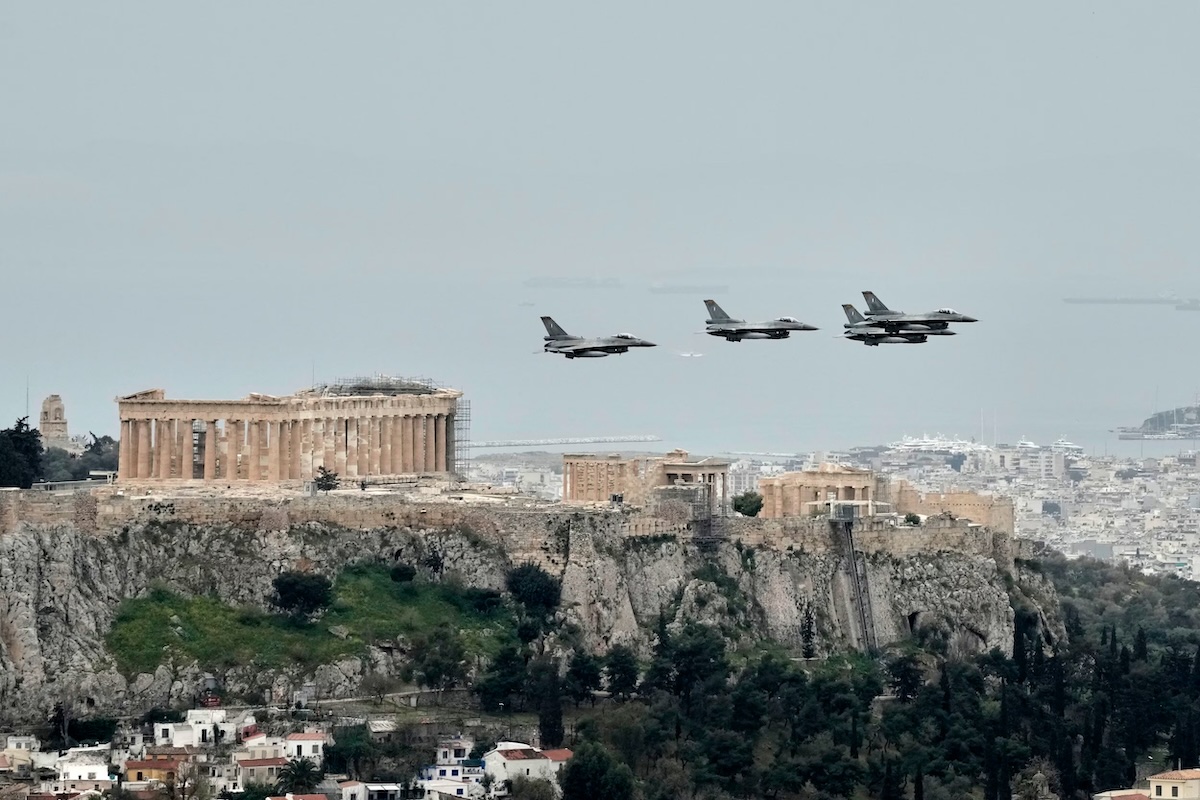
The dominant security development was the approval by KYSEA of eleven defence programmes worth €4.2 billion, headlined by the €3.1 billion "Achilles' Shield" air defence system combining Israeli-made Spyder, Barak MX and David's Sling platforms, with domestic industrial participation secured at over €700 million — 25% of project value, meeting the government's own threshold. The package also includes three Embraer C-390 transport aircraft, ten VICTA special operations vessels, additional Hellfire stocks, V-BAT drones, micro-satellites with synthetic aperture radar, HERON-1 UAVs and sonar systems for the navy's MEKO frigates.
The first disbursement under the EU's SAFE programme — €118.2 million, representing a 15% advance on Greece's €787.7 million allocation — arrived simultaneously, linking the national procurement push to the broader ReArm Europe framework. Greece and Cyprus also advanced a joint UCAV co-production proposal under SAFE, with ALTUS-LSA's Kerveros drone having completed live-fire trials. On the F-35 front, a US State Department letter to Congress dated 22 July confirmed that Turkey has not yet met the legal requirements for re-entry into the programme — a formal reaffirmation of CAATSA constraints that Athens welcomed, even as the letter simultaneously acknowledged that Washington-Ankara negotiations on resolving the S-400 dispute remain ongoing and that Turkey has been credited with constructive roles in several US regional diplomatic initiatives.
On the wider geopolitical front, Greece emerged as the final holdout in negotiations over the EU's 21st Russia sanctions package before accepting a compromise that includes a renewable one-year exemption allowing companies to transport Russian LNG to third countries — a carve-out protecting Greek shipping interests, including Dynagas, at the cost of a weakened overall package. The European Commission kept all four rule of law recommendations issued to Greece last year, crediting progress on judicial reform, anti-corruption strategy and media law while flagging persistent concerns over corruption convictions, lobbying transparency, journalist protection and civil society cooperation. EPPO investigations into EU funds used for migrant food services and accommodation in Greece have advanced to the point of searching the Ministry of Migration and Asylum.
Meanwhile Greece's National Housing Strategy 2026-2035 was approved, comprising 50 measures with a combined budget of €6.5 billion across three pillars: increasing housing supply, targeted household support and permanent institutional oversight. The European Commission approved Greece's Recovery and Resilience Plan amendment, clearing the path to the Council's final approval and the ultimate disbursement of EU funds. The EIB confirmed technical assistance for critical infrastructure resilience, focusing on energy and water networks.
Domestically, Mitsotakis launched the €23 billion National Development Programme 2026-2030, funded entirely from national resources and intended to serve as the successor development instrument to the expiring Recovery Fund, organised across 37 programmes covering infrastructure, digital transformation, climate adaptation, innovation and social cohesion. He simultaneously signalled the shape of the September Thessaloniki Fair address — a focus on the middle class, freelancers and SMEs, framed as a "Greece 2030 roadmap" rather than an annual promise list — while candidly acknowledging that the final fiscal package is still being calibrated against tourism revenues, energy prices and Brussels's early view of the 2027 budget. The government's price-reduction strategy is also taking shape, centred on a deal with major retailers to freeze or cut prices on key household goods from September, alongside a parallel arrangement with refineries on fuel prices — both contingent on Middle East stability.
On the political fault lines, coalition speculation intensified following comments by ND lawmaker Vlachos and Health Minister Georgiadis that a post-election arrangement with a Samaras party might be conceivable — prompting swift pushback from spokesman Marinakis and Deputy PM Hatzidakis, who reiterated the single-majority objective. Mitsotakis has not yet fixed the election date, but the Thessaloniki Fair on 5 September is the acknowledged decision point. SYRIZA, meanwhile, elected Rena Dourou as parliamentary group leader — the party's only candidate after Polakis withdrew — leaving it with ten lawmakers from an original 47 after a further wave of defections this week. Tsipras used his first major ELAS online event to defend a "governing left" posture, explicitly positioning the movement against what he called a "left of protest" and criticising parties that avoid the burdens of power — a thinly veiled critique of the Communist Party.
The economic data this week was broadly positive at the headline level. Greece's debt-to-GDP ratio fell to 143.5% in Q1 2026, a year-on-year drop of 9.4 percentage points — the largest reduction in the EU over the period — though Greece retains the highest ratio in the bloc, now 4.6 points above Italy. The four systemic banks are expected to report combined first-half net profits of approximately €2.3 billion, with net interest margins at around 2.7%, well above the eurozone average, and rate sensitivity providing further upside. The first cryptocurrency operating licences were issued by the Hellenic Capital Market Commission.
Yet the structural picture remains sobering. The IOBE NEET report found that 13.6% of Greeks aged 15-29 are outside employment, education or training — above the EU average — with the most striking anomaly being that university graduates record the highest NEET rate at nearly 20%, the reverse of every other EU country, pointing to a fundamental disconnect between higher education and the labour market. Consumer stress indicators from McKinsey confirm the household pressure: 63% of Greek consumers plan to reduce food spending, against 50% across the EU, with private-label penetration still at 24% compared to 40% in Europe. Tourism remains a bright spot, with long-haul markets — the US, Australia, and an emerging India opportunity — increasingly central to a value-over-volume strategic shift, supported by new direct routes from Athens to India and expanding US connectivity.
Taken together, this week captures a Greece making genuine strategic and institutional strides — in defence, development planning, capital markets regulation and EU positioning — while the underlying social and economic contract with its citizens, from youth employment to food affordability to housing, remains under pressure that headline growth figures continue to obscure.