

On the security and naval front, Greece's navy is preparing to contribute two units — a MEKO-class frigate currently engaged in EU Operation Aspides and the support vessel Prometheus — to an expanded mission addressing mine-clearing in the Strait of Hormuz. Three scenarios are under consideration, ranging from a six-month mission with Iranian tolerance to a full collapse of the underlying agreement. Defence Minister Dendias has previously criticised EU partners' reluctance to contribute to Aspides, and with Greece holding operational command at sea, Athens could find itself in an increasingly pivotal regional role. PM Mitsotakis, addressing EU leaders in Brussels, welcomed the US-Iran agreement on the Gulf crisis and called for restored freedom of shipping, while pressing partners on common EU defence financing. He also met Ukrainian President Zelenskyy, reiterating support while stressing that "operations must not spill outside the war zone" — a direct reference to the Ukrainian drone incident off Lefkada.
Tensions with Turkey deepened on multiple fronts. The European Parliament adopted a strongly worded resolution condemning Ankara's violations of Greek and Cypriot sovereign rights and its Blue Homeland doctrine, calling for possible targeted sanctions against Turkish officials, while still describing Turkey as a key NATO ally. Turkey's Foreign Ministry dismissed the resolution as driven by "misinformation." Separately, a new Libya-Turkey-linked offshore exploration deal involving TPAO, Repsol, MOL, Eni and QatarEnergy has drawn sharp criticism in Athens, which sees it as entrenching the disputed 2019 Turkey-Libya maritime memorandum — with particular frustration directed at the participation of EU member states Spain, Italy and Hungary.
Meanwhile, in Washington, the Senate Foreign Relations Committee advanced the Eastern Mediterranean Gateway Act, welcomed by Greek-American advocacy groups as reinforcing the US-Greece-Cyprus-Israel "3+1" framework and supporting the India-Middle East-Europe Economic Corridor. On Albania, Foreign Minister Gerapetritis warned that respect for the Greek minority's property rights is a precondition for Tirana's EU accession, amid ongoing protests over the Kushner-linked coastal development.
Domestically, polling continues to show New Democracy comfortably ahead at 23.3%, with ELAS at 14.2% and PASOK falling to third at 10.3%, overtaken following ELAS's launch. Karystianou's Hope for Democracy stands at 8.1%. Internal ND data reveals a striking geographic divide: the party significantly outperforms its national average in Attica but underperforms by up to 8-10 points in northern regions and rural constituencies — a reversal of its traditional rural strongholds. Pollsters point to a sense of state abandonment in smaller towns, compounded by anger over the crackdown on the farm subsidy fraud scheme.
The government is responding with a dual strategy: reinforcing the message that the election will be decided in a single decisive vote — aimed at countering former PM Samaras's narrative that the contest is merely a preliminary round — while preparing a fiscal package worth more than €2 billion, expected to be unveiled at September's Thessaloniki Fair, including a minimum wage increase toward €950 by 2027, property tax relief and expanded housing support.
In a notable judicial development, the Supreme Court ordered convicted "November 17" terrorist leader Alexandros Giotopoulos back to prison less than three weeks after his release, ruling that the applicable law required 25 years served, not 19, before eligibility for conditional release.
On the economic front, Deputy PM Hatzidakis sought to reassure markets that the end of the Recovery Fund will not create a financing gap, citing an expected €49.5 billion in EU funding for the next programming period plus access to a new €420 billion European Competitiveness Fund, of which Greece could receive €8-10 billion. Public debt rose slightly to €406.1 billion in 2025, though the debt-to-GDP ratio continued its sharp decline to 146%, down from 209% in 2020. The state budget posted a primary surplus of €3.64 billion in the January-May period, well above target. Greece also repaid €6.9 billion of its first bailout loans ahead of schedule. The Bank of Greece, however, projects inflation will rise to 3.8% in 2026 — above the eurozone average — driven by energy prices, before easing to 2.6% in 2027.
On demographics and society, ELSTAT data confirmed a continued downturn: live births fell 4.2% in 2025 to 65,594, down 39% since 2005, with childbirth increasingly shifting to older age groups and births to foreign mothers declining. Only Crete recorded an increase among Greece's regions. In education, Greek universities slipped across the board in the QS World Rankings, though three institutions debuted for the first time.
On a more positive note, Greece recorded some of the EU's cleanest bathing waters, with 97.1% of sites rated excellent.
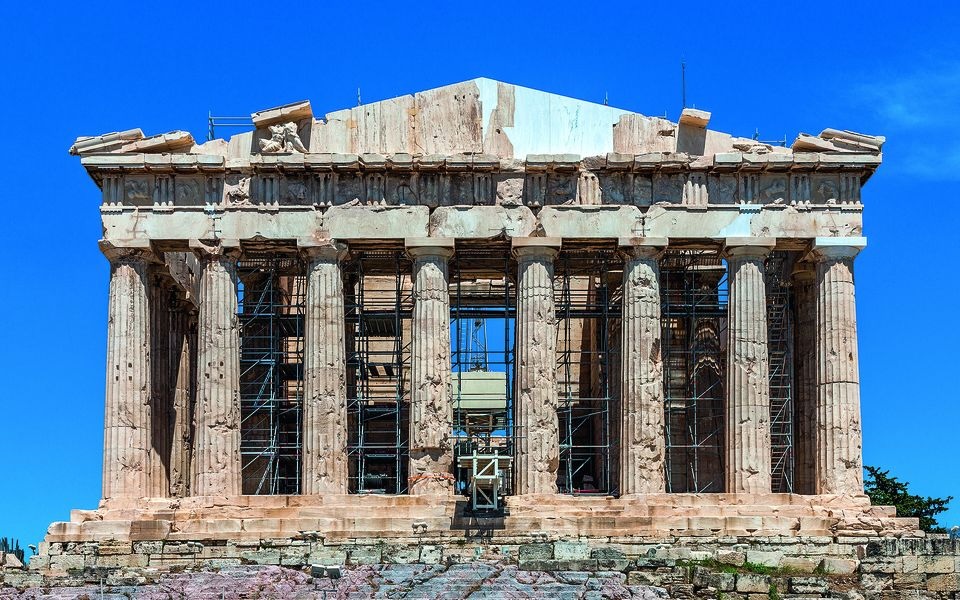
Culturally, the Parthenon's western facade was unveiled scaffolding-free for the first time in roughly 220 years, marking a landmark restoration milestone.
Taken together, the week underscores a Greece navigating an increasingly active security role abroad, a domestic election landscape shaped as much by geography and fiscal promises as by ideology, and a longer-term demographic and educational challenge that fiscal stability alone cannot resolve.
* Written from Athens. Focused on power, institutions and political behavior — beyond the headlines.