

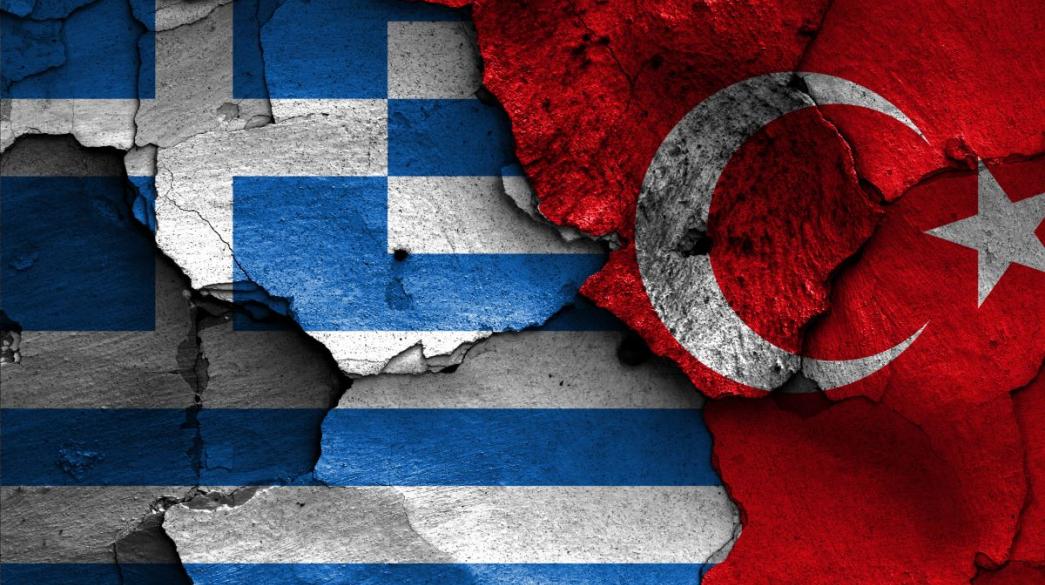
Athens lodged formal verbal and written demarches with Kyiv after a Ukrainian Cossack Mamai unmanned surface vehicle operated in the Ionian Sea near Lefkada. Greece raised four objections: the transfer of military operations into the Mediterranean far from the active front; risks to civilian maritime traffic and the environment; the limits of self-defence as legal justification; and a call to cease such operations. Foreign Minister Gerapetritis briefed EU, NATO and Ukrainian counterparts at an informal ministers' meeting in Limassol. Kyiv has not yet responded.
Turkey's "Blue Homeland" maritime jurisdiction legislation is now expected to be delayed until October, attributed to parliamentary scheduling but also, analysts suggest, to Ankara's reluctance to raise tensions ahead of a NATO summit expected to be attended by President Trump. Athens has reportedly explored counter-measures including marine park declarations in the eastern Aegean and an extension of territorial waters south of Crete. On the F-35 question, Secretary of State Rubio confirmed before Congress that existing statute prevents the administration from altering Turkey's exclusion from the programme while it retains the S-400 system — a reminder that the legal constraints binding Washington on this issue remain firmly in place.
PM Mitsotakis visited Bulgaria to reinforce cooperation on the Vertical Gas Corridor, a proposed land transport corridor to Ukraine via Bulgaria and Romania, and Western Balkan EU accession. Defence Minister Dendias, at the Balkan Chiefs of Staff Conference in Thessaloniki, called for coordinated regional responses to hybrid threats, cyberattacks and the weaponisation of migration, framing Balkan stability as a core Greek national interest.
On migration, Crete has overtaken the eastern Aegean as Greece's primary entry point, with nearly 6,000 arrivals from eastern Libya recorded so far this year — roughly half of the national total — and the government has signalled unspecified "drastic" action. A parallel controversy has emerged over a $4 billion Albanian coastal development linked to Jared Kushner, where Albanian media — one outlet using an AI-generated image — sought to frame domestic opposition from ethnic Greek residents as Greek state interference. The incident is under investigation by Albania's anti-corruption authority.
Domestically, New Democracy submitted a constitutional reform proposal to parliament covering ministerial criminal liability, judicial appointments, protection against retroactive taxation and performance-linked civil service tenure — a multi-stage process requiring heightened majorities. At the same time, New Left's parliamentary group was dissolved after falling below the minimum threshold, reducing recognised groups from eight to seven and raising the independent bloc to 39 MPs.
Polling shows ND leading at 25.5%, with Tsipras' new Greek Left Alliance second at 13.5%, ahead of PASOK at 10% and Karystianou's Hope for Democracy at 9.5%. ND's advantage is substantial but the party remains below self-sufficiency, with 12% undecided voters a critical variable. Officials are watching closely whether the new political formations erode the conservative base or, as some in government assess, end up consolidating it.
On the economic front, Greece received its clearest validation in over a decade with the European Commission removing it from the list of member states experiencing macroeconomic imbalances for the first time since the debt crisis. Yet the accompanying country report tempered optimism considerably: real GDP remains roughly 14% below its 2008 peak, per capita income stands at 68.4% of the EU average, and labour productivity at just 54.6% — the lowest in the bloc despite Greeks working the most hours per employee. Long-term convergence is projected at only around 1.5% annually.
Housing affordability has deteriorated markedly, with the Bank of Greece governor linking it directly to delayed household formation and demographic decline among younger cohorts. The Commission, OECD, IMF and Bank of Greece have collectively called for a review of Greece's 1,236 tax exemptions — totalling €22.88 billion in 2024, or 30.9% of total tax revenues — noting the absence of any permanent evaluation mechanism.
These structural pressures are compounded by accelerating climate costs. Allianz Trade estimates recurrent heat waves could reduce GDP by up to 4.1% and investment by 8% by 2030, while pushing inflation up by 2.5% and unemployment by one percentage point — a cumulative loss of up to €13 billion. Karpathos became the latest island declared in a state of emergency over drinking water shortages, joining a growing list that includes Corfu, Leros, Patmos, Astypalea, Symi, Meganissi and Greater Athens, with mass tourism identified as a key aggravating factor. A draft bill transposing EU Directive 2023/970 on gender pay equity was also opened for public consultation, while Greece has exceeded several larger EU economies in approved European research programme projects, though it remains classified as a "Moderate Innovator" ranked 24th in the EU, with SMEs largely absent from European funding instruments.
Taken together, this week's developments point to a Greece that is more confident in projecting regional influence — from the Aegean to the Balkans — yet still navigating a domestic landscape shaped by political fragmentation, unresolved structural weaknesses, and the mounting costs of climate change.
* Written from Athens. Focused on power, institutions and political behavior — beyond the headlines.