

Athens enters the weekend under heightened security as the city hosts the EuroLeague Final Four for the first time in nearly two decades. Thousands of police officers, drones, aerial surveillance systems and extensive movement restrictions are deployed around OAKA and central Athens as authorities seek to avoid incidents during one of Europe’s largest basketball events. At the same time, officials are still unable to explain the strong odor that spread across large parts of the capital earlier this week, with investigations focusing on possible mercaptan transport or chemical cargo activity near the port area.
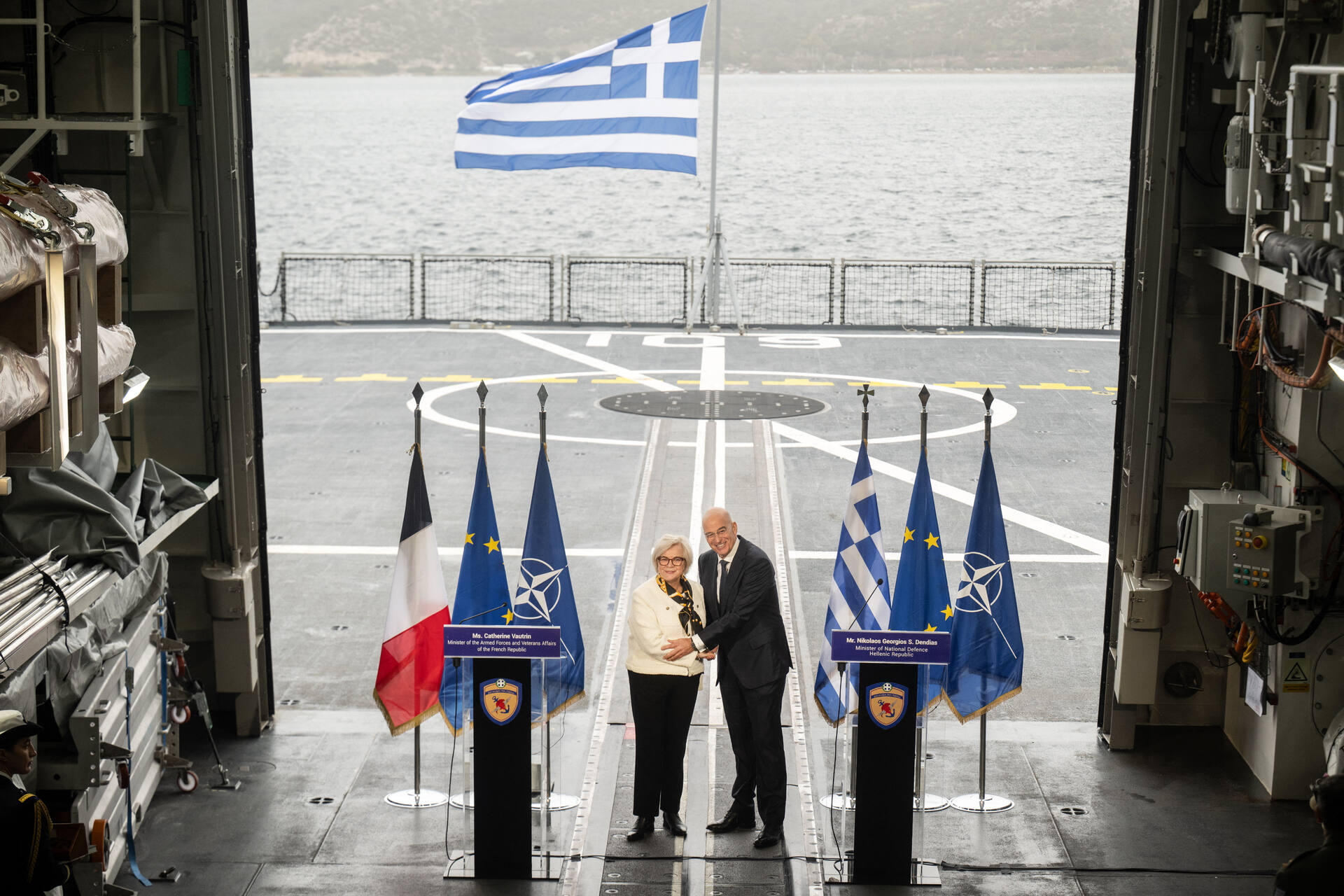
Regional security tensions continue to shape Athens’ strategic posture. Greece has deployed two Mirage 2000-5 fighter jets to Karpathos to demonstrate that the earlier repositioning of Patriot missile systems does not represent a concession to Turkish pressure. The move comes amid renewed friction over Ankara’s proposed “Blue Homeland” legislation and broader Eastern Mediterranean disputes. Defense Minister Nikos Dendias also publicly criticizes Ukraine following the discovery of an alleged Ukrainian naval drone near Lefkada, warning that an attack on civilian shipping could have caused mass casualties and signaling growing Greek concerns over any spillover of the Black Sea conflict into the Mediterranean.
Prime Minister Kyriakos Mitsotakis meanwhile uses a series of interventions this week to underline both Greece’s geopolitical importance and Europe’s need for greater strategic autonomy. Speaking to the Financial Times, Mitsotakis warns that instability in the Middle East threatens global trade, shipping routes and energy security, while defending stronger European defense coordination alongside NATO. Domestically, he signals that the government is entering a more politically focused phase ahead of the next elections, stressing that “every month counts” during the final year of the administration’s mandate.
Political uncertainty is increasingly becoming part of the economic debate. Moody’s warns that Greece could face renewed instability if future elections produce fragmented outcomes and prolonged coalition negotiations. While acknowledging Greece’s strong fiscal recovery since the debt crisis, the ratings agency highlights the country’s continued vulnerability due to its high debt burden and dependence on market confidence. At the same time, the expected launch of new political movements linked to Alexis Tsipras and Maria Karystianou is further fragmenting the opposition landscape and intensifying competition for second place behind New Democracy.
On the economic front, the European Commission forecasts slower growth and higher inflation across Europe due to the Middle East energy shock. Greece is still expected to outperform the eurozone average, but higher fuel and electricity costs are projected to weigh on households and businesses. Concerns are also growing after Greece exhausted its Recovery Fund loan resources ahead of schedule, leaving billions of euros in projects seeking alternative financing at higher borrowing costs.
The government is simultaneously accelerating structural and technological reforms. Authorities are preparing a €150 million AI support program for SMEs while introducing new safeguards governing AI use in schools. A new Local Government Code also proposes significant changes, including abolishing second-round municipal elections and introducing electronic voting. However, new labor market surveys continue to expose deep structural weaknesses, with major wage disparities between small and large businesses and a significant mismatch between workers’ qualifications and actual employment.
* Written from Athens. Focused on power, institutions and political behavior — beyond the headlines.