Greece took the rotating UN Security Council presidency on 1 October, its second stint in a 2025-26 term that ends in December, with Ambassador Balta presiding over a body grappling simultaneously with Ukraine, the Gaza ceasefire, Hormuz tensions, Sudan and Haiti. The presidency carries an additional dimension: if the Security Council reaches agreement this month on a successor to Guterres, the recommendation could come under Greece's watch. Turkey's reported push for veteran diplomat Feridun Sinirlioglu — formerly Turkey's UN representative and currently OSCE Secretary-General, with extensive background on eastern Mediterranean maritime claims — is being monitored carefully in Athens, though French opposition and the absence of strong P5 consensus make the candidacy uncertain. Mitsotakis used his UNGA address earlier to position Greece as a stability anchor in the eastern Mediterranean, pressing Turkey on the casus belli and meaningful dialogue preconditions, reaffirming support for Ukraine and backing a two-state solution for Gaza.
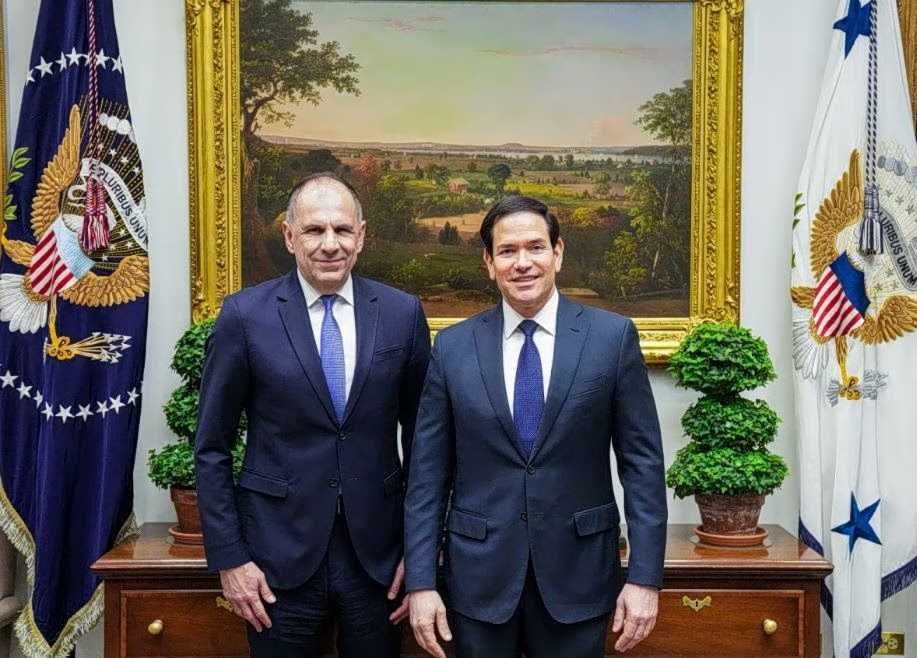
US Secretary of State Rubio is expected in Athens on 6-7 October for the sixth round of the US-Greece Strategic Dialogue — a visit framed in Athens as a signal of bilateral depth rather than a routine regional stop. Discussions will cover the Mutual Defense Cooperation Agreement, defence cooperation, the territorial waters extension south of Crete, the Great Sea Interconnector resumption and LNG export frameworks, alongside Ukraine and Middle East developments.
Greece is simultaneously extending its Patriot battery deployment in Saudi Arabia on a rolling monthly basis — its crews having successfully engaged twelve ballistic missiles and Iranian drones — with Mitsotakis due to visit Riyadh later this month. Turkey issued a new Navtex notice, code 0953/26, covering survey activity by the Oruc Reis and three accompanying vessels over pipeline work toward Turkish-occupied northern Cyprus — which Athens immediately rejected as illegal, describing it as "one more provocative, unilateral act" undermining regional stability during a sensitive period. Greece's marine parks secured EU funding, advancing their implementation while awaiting the final presidential decrees.
Domestically, the Tempe rail disaster opened a new political chapter with the Supreme Court's judicial council referring former deputy minister Triantopoulos to a special court on breach of duty charges related to post-crash site management — a development that will reopen one of the most politically sensitive cases of the current term. Triantopoulos announced he will not seek re-election. The government emphasised judicial independence; the opposition called it an overdue reckoning.
The social media under-15 ban is proceeding to legislation for 1 January 2027 implementation, with the revised approach designed to address the European Commission's TRIS concerns by avoiding mandatory prescription of a specific age-verification method. Athens acknowledges the legislation may need adjustment once the EU KIDS Act becomes binding.
Polling continues to show the familiar paradox: New Democracy leads at around 24-25%, ELAS at 13-14% and PASOK recovering slightly toward 11%, with a seat projection suggesting ND would need a coalition partner. The more notable shift this week is the emerging ELAS-PASOK dynamic: post-TIF polling from three separate firms showed ELAS stabilising or declining while PASOK gained, reopening the question of whether ELAS has hit a ceiling or is experiencing a temporary correction. Tsipras responded with an assertive "either us or nobody" framing; PASOK dismissed it as arrogance. The government's internal focus remains on the "three plus three" electoral risks — inflation, a potential Turkish crisis and a new scandal forming the visible triad; rural erosion, right-wing defections and abstention dynamics forming the quieter one. Turnout is increasingly treated as a swing variable: two million voters have left the rolls since 2004, and which parties can mobilise them may matter as much as headline polling shares.
The economy produced its now-familiar split picture. Greece submitted the final two RRF payment requests — €4.4 billion in grants and €2.35 billion in loans — closing the programme formally, though Public Investment Programme funding will drop sharply from €16.7 billion this year to €10.6 billion in 2027 before recovering. Post-RRF financing will flow through the National Development Programme, the new Social Climate Fund, the 2028-2034 Cohesion Policy programme and an expected €49 billion-plus from the next MFF.
Greece is preparing up to €200 million in additional energy support for the winter, on top of €800 million already deployed, but is deliberately staging announcements to monitor international oil market developments and the G7 strategic reserve coordination being promoted by Macron and IEA chief Birol. The government faces an unusual constraint: it has the fiscal savings but limited room under EU spending cap rules to deploy them. On the positive side, Morningstar DBRS projects 1.8% growth for 2026 and 2027, with Greece remaining among Europe's outperformers. Finance Minister Pierrakakis's European Spectrum Union proposal — channelling 6G spectrum auction proceeds toward EU budget financing — is gaining traction in MFF discussions. Household overdue debt reached €238.6 billion, or 96.1% of GDP, with tax and social security obligations accounting for 70% of the total — a stock that is rising even as NPLs decline, pointing to embedded payment difficulties that economic growth alone is not resolving.
On structural and institutional matters, the 2025 PISA results confirmed that Greece's education system remains in difficulty across all three domains, with one in two students unable to perform basic mathematical reasoning. The public-private gap narrowed modestly but persists, with public schools reporting higher staff-to-student ratios, greater material shortages and higher absenteeism. The EU Council presidency in H2 2027 is being prepared, though election timing, civil service capacity constraints and low public EU engagement are identified risks to its impact. Multiple EU infringement proceedings were opened or escalated against Greece this week — on landfills and waste management, electricity market design, hydrogen and gas market rules, anti-money laundering and human trafficking directives — a reminder that compliance capacity remains stretched even as institutional credibility at the macro level improves.
Taken together, this is a Greece actively deploying its diplomatic and security assets — UN presidency, Rubio visit, Saudi deployment, Israel alignment — while managing an economy where fiscal headline strength coexists with household debt, energy vulnerability and a pre-electoral political landscape in which the government's lead is secure but its majority is not.