

The most consequential geopolitical development was the eastern Libyan parliament’s ratification of the 2019 Turkey-Libya maritime memorandum, which Greece immediately brought to the UN Security Council — under its current presidency — with Ambassador Balta briefing members on the risks to regional security and stability. The EU rejected the deal as infringing third-state sovereign rights, Egypt aligned with Athens, and the US State Department limited itself to encouraging “good-faith negotiations” among eastern Mediterranean partners while reiterating its preference for direct Athens-Ankara dialogue. Greece is signalling it has leverage — Marinakis noted that EU funding to Libya and UN peacekeeping-related transfers pass through Athens — and Gerapetritis used the episode to reactivate direct coordination with Egypt on EEZ delimitation. The practical security consequence was immediate: a sharp spike in Libya-Crete migration arrivals, with 1,194 people landing between 19-21 October alone. Athens is preparing for the possibility that a Libya now more closely aligned with Ankara could allow smuggling networks to operate unchecked, and is pre-positioning tents and supplies in Crete while examining naval frigate deployment as deterrence.
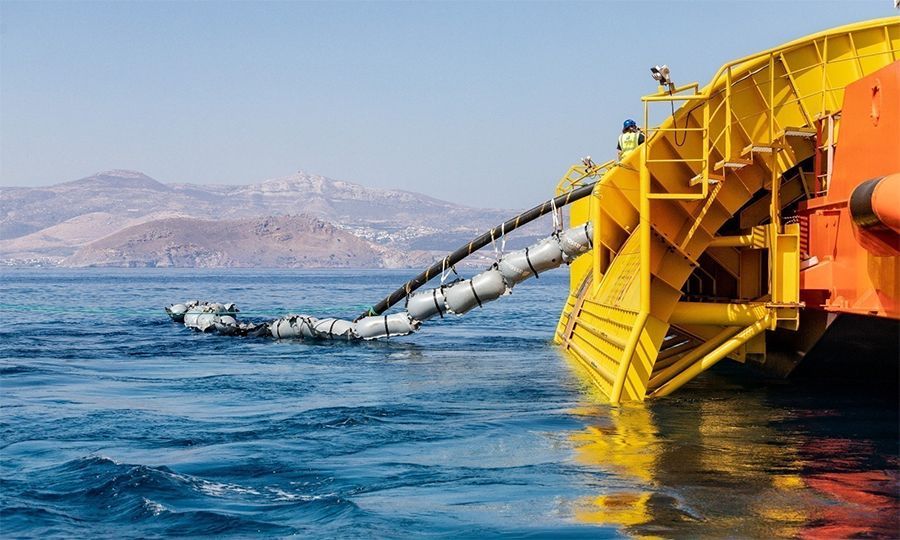
On the Great Sea Interconnector, a narrow diplomatic opening appeared. Athens interpreted Fidan’s language — that written rather than verbal notification would be needed when surveys begin, without using the word “permit” — as potentially leaving room for a workable formula. The Greek position is that notification does not constitute authorisation, and that Greece alone grants authorisation. The Abeille Marengo remained in Naples pending the interministerial committee decision, with Nexans seeking a permit covering through end-2026. Turkish Blue Homeland legislation has again slipped the autumn parliamentary calendar, with Ankara watching closely how Athens proceeds on the cable and the broader maritime planning framework.
Domestically, the social media under-15 ban passed Parliament late last night with only New Democracy voting in favour, PASOK abstaining and all other opposition parties voting against. The government has framed enforcement as a platform-side obligation, with privacy-preserving age verification and DSA cooperation mechanisms as the implementation architecture, but significant legal and operational uncertainties remain — particularly around enforceability against platforms domiciled in other EU member states. The political logic is clear: 80% public approval and relevance to a 45-54 parent demographic where ND support has fallen nearly 19 points. Whether a difficult rollout converts that approval into votes is the open question.
The military restructuring plan announced by Defense Minister Dendias adds a further piece to the defence modernisation picture: €1.1 billion in projected savings over five years through consolidating 56 units, closing 126 facilities and retiring high-maintenance equipment, with reinvestment targeted at personnel pay and new systems. FDI Belharra frigates cost 73% less to operate annually than the S-class vessels they replace, illustrating the efficiency logic. Basketball match-fixing allegations prompted the suspension of all state grants to the Hellenic Basketball Federation and a financial audit covering three fiscal years.
On the US relationship, Rubio gave Breitbart News an interview specifically addressing the Guilfoyle departure, explicitly rejecting any suggestion that it represented a downgrading of the Athens relationship and promising a successor with direct Trump access. No name or timetable was offered. The question of whether Trump nominates a political ally — as seems more likely than a career diplomat — and whether the confirmation clears before January’s potential Senate shift, remains the principal near-term variable for bilateral management.
Now, in inner politics, the electoral arithmetic is sharpening. Two new polls both project ND at 30%, with ELAS at around 15-16.5% and PASOK at 13%, producing a nine-party parliament in which ND falls well short of a governing majority. The Alliance of Greeks — Kasidiaris-adjacent — is projected to enter parliament, complicating the arithmetic further. Mitsotakis has set 25% as his personal leadership floor and is privately targeting above 28% — the 2024 European election benchmark — with 30% as the aspirational ceiling. His American strategist Stan Greenberg’s latest focus group findings identify Samaras as the primary threat because he draws from the same conservative voter pool, while Tsipras is seen negatively by centrist and undecided voters and Androulakis as weak. Greenberg recommends a restrained campaign emphasising crisis management competence and acknowledging mistakes, warning against polarisation. PASOK is reading recent polling more favourably, noting it is attracting direct ND defectors while ELAS is not, and is focusing consolidation efforts on Attica where it is structurally weaker than in the provinces.
The economic picture combined institutional achievements with structural warnings. IOBE revised inflation up to 4% for 2026 and 3% for 2027, warning that persistently high prices are eroding private consumption — the key growth driver — with consumption growth now expected at just 1.4% in 2026 and 1.5% in 2027. The European Commission’s Employment and Social Outlook confirmed Greece at 27.5% poverty and social exclusion risk — second only to Bulgaria — with real wages still 0.1% below 2019 levels despite nominal increases exceeding Germany, France and Spain. Tourism delivered 28 million arrivals and €18.1 billion in revenues in January-August, up 10% and 9.4% respectively.
Seventeen Greek investors, including all four systemic banks, committed $70 million to the Endeavor Catalyst Fund V, covering 22% of a $320 million fund. FDI project data from EY showed Greece rising to 19th in European rankings with 47 projects in 2025, though 79% were concentrated in Attica — up from 57% the previous three years — deepening a geographic imbalance that fiscal and tourism aggregates tend to obscure.
In good news, Michelin expanded its Greece guide to include Thessaloniki and Santorini, with 62 total listings including 20 starred restaurants, and Lycabettus in Oia earning two stars.
Taken together, this week captures a Greece operating simultaneously at the centre of multiple acute pressures — Libya’s maritime realignment, migration surge, GSI brinkmanship, ambassador vacancy — while its domestic political season enters the final stretch before a spring 2027 election in which the governing party’s central problem remains unchanged: a commanding lead that does not translate into a governing majority.