

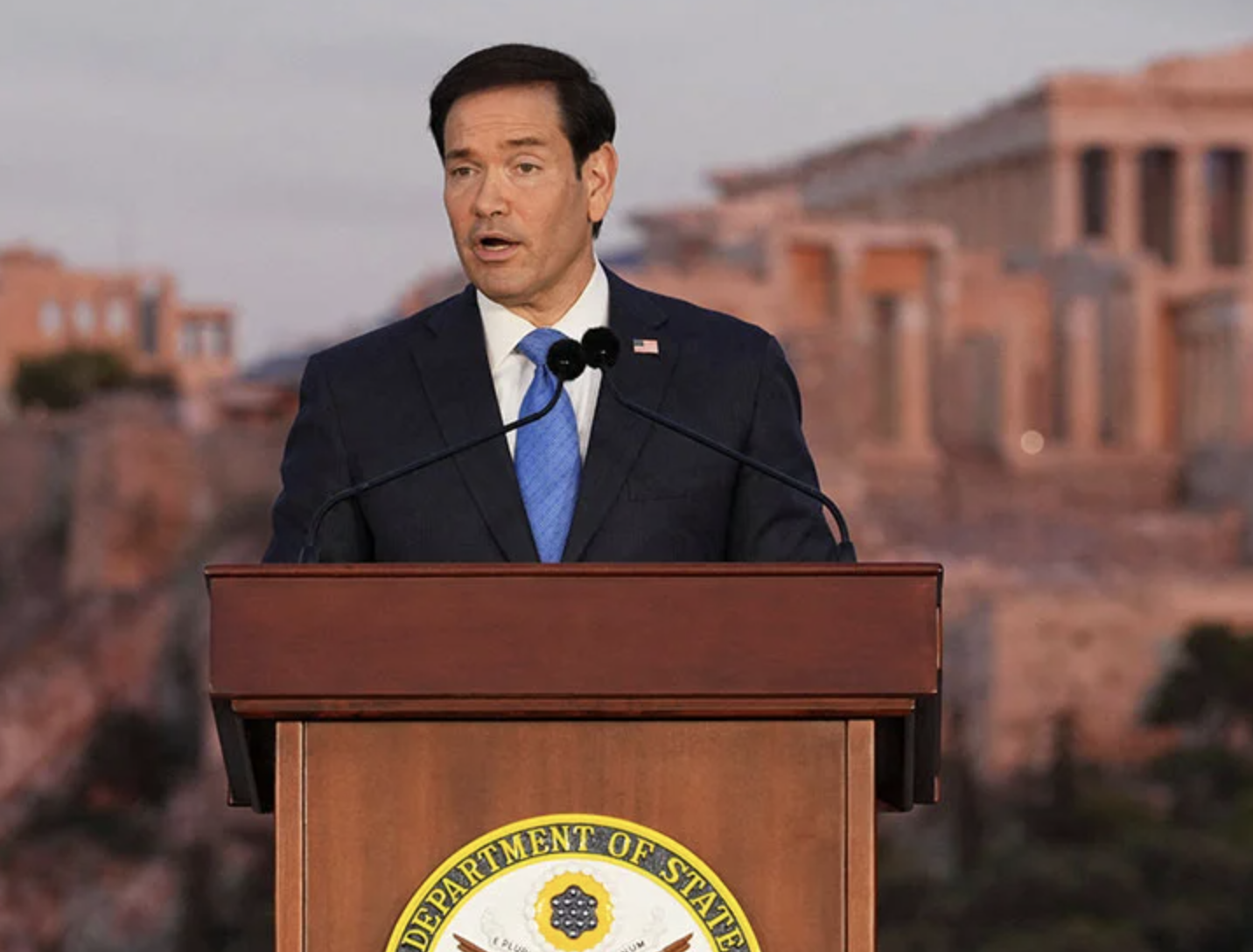
Marco Rubio's visit was the centrepiece. The sixth round of the US-Greece Strategic Dialogue produced $4 billion in Foreign Military Sales: approximately $1.2 billion in missiles and precision munitions for the F-16 and forthcoming F-35 fleet, $1 billion for the upgrade of 37 F-16 Block 50s to Viper standard by end-2027, $800 million in support for older F-16s, and $750 million for MH-60 and Black Hawk helicopter follow-on support. Greece also joined the National Guard Bureau’s State Partnership Program with Florida and will receive Stryker vehicles. A seafarer certification agreement on Greek-flagged vessels was signed. On the technology side, Greece’s Pax Silica membership was activated into concrete cooperation on AI, high-performance computing and cybersecurity.
Rubio’s speech at the Pnyx — beneath the Acropolis at sunset — was as much a symbolic gesture as a diplomatic one, framing the transatlantic relationship in explicitly civilisational terms. Mitsotakis described bilateral relations as being “at their highest level ever”; Rubio called it “a very strong partnership” where the two sides “most of the time agree on the right solution.” The absence of a parallel Ankara visit drew commentary, though analysts in Athens noted that Rubio had visited Turkey during the NATO summit and that the Trump administration’s transactional approach does not follow conventional balance-of-visits logic. What Athens read clearly, however, is that Washington sees Greece as having acquired strategic utility — in energy, defence and connectivity — that is increasingly autonomous rather than derivative of its NATO neighbourhood. Rubio is reported to have received an extensive briefing on Greek-Turkish tensions and to have conveyed that Washington will not tolerate a crisis that destabilises the Eastern Mediterranean energy architecture. Greece followed the visit by announcing it will issue a Navtex within days on the resumption of Great Sea Interconnector seabed surveys — without seeking Turkish permission — pressing ahead before the French electoral calendar creates further delays for Meridiam and Nexans.
On the geopolitical canvas beyond the bilateral, Mitsotakis pressed Mediterranean EU partners at the MED9 meeting in Split for additional EU energy support measures and welcomed Commission backing for Greece’s European Emergency Migration Mechanism proposal. Migration Minister Plevris announced a post-Christmas agreement for Return Hubs in Africa in cooperation with the Netherlands, Denmark, Austria and Germany, with implementation planned for 2027, while noting that Aegean maritime arrivals have fallen to historically low levels — around 6,000 in the first nine months — even as the Libya-Crete route remains active at approximately 16,000. Greece also achieved normalisation in the US Visa Waiver Programme after a decade of enhanced scrutiny, following the rollout of five million biometric identity cards and upgraded border controls. Russia appointed a new ambassador to Athens — Yuri Gorlach, a former deputy permanent representative to NATO with a background in pan-European cooperation — replacing Maslov after twelve years.
Domestically, internal ND tracking polls paint a precise picture of the party’s electoral challenge: a 30% loss of its 2023 voter base, equivalent to approximately 10 percentage points, distributed almost equally between defections to the right — Voice of Reason, Greek Solution — and to the centre-left, primarily PASOK and ELAS. The symmetry of the loss creates a strategic dilemma Mitsotakis has so far addressed by maintaining parallel messaging on defence and migration for conservative voters while continuing centrist outreach. The government’s retention rate stands at 70%, with the highest current projection reaching 31% even after statistical adjustment. Former defence minister Apostolakis joined PASOK’s parliamentary group, bringing it to 35 seats — a small but symbolically meaningful consolidation for a party seeking to cement its position as the credible centre-left opposition. The PYRKAL urban regeneration and ministry relocation project advanced, with four bidders selected and a winner expected mid-2027.
A cryptocurrency capital gains tax at 10% — revised down from an earlier 15% indication — was published for public consultation, with a €500 annual exemption threshold and a November parliamentary timetable.
The Hellenic Fiscal Council endorsed the draft 2027 budget’s macroeconomic framework while flagging three risk clusters: higher borrowing costs as the ECB tightens further, rising energy prices and the post-Recovery Fund investment transition. Growth projections of 1.9% for 2026 and 2.0-2.3% for 2027 are broadly endorsed, though the 7.9% investment growth assumption for 2027 is seen as ambitious. The primary surplus is estimated at 3.6% of GDP in 2026, the public debt ratio falling to 136.8% this year and 128.8% in 2027 — still the highest in the EU. The Council flags that net expenditure growth has exceeded recommended ceilings across 2024-2027 cumulatively, though defence and energy flexibility clauses bring the enhanced control account to near-zero rather than breach.
FDI nearly doubled to €7.6 billion in January-July, building on a record 2025, with energy transactions and the UniCredit-Alpha Bank deal among the drivers — though the concentration of investment in services, energy and real estate, rather than manufacturing, remains a structural concern. Greece’s AI adoption rate among businesses rose to 47% — growing at 38% annually against a European average of 29% — with 82% of citizens reporting familiarity with the technology, though only 17% of businesses have reached advanced integration and skills shortages remain the primary constraint. Consumer confidence improved to -41.6 in September from -47.8 in July, but Greece remains last in the EU, with 58% of households barely covering expenses and 60% reporting deteriorating finances over the past year.
Taken together, this is a Greece operating at two speeds simultaneously: a strengthening external strategic position — anchored by the Rubio visit, the $4 billion defence package, normalised Visa Waiver status and record FDI — and a domestic social economy in which the majority of households are under financial stress, the governing party has shed a third of its 2023 electorate, and the energy cost challenge is heading into a difficult winter without a clear resolution.